UK deep-tech engineering consultancy · Manchester
The hard problem.The whole stack.
Embedded Linux and firmware development from Manchester, UK. Most consultancies own one layer and hand you the rest as somebody else’s problem. We work from FPGA and board bring-up through embedded Linux, edge AI and industrial vision, up to the protocols that make it all interoperate.
Fixed scope · Engineer to engineer · No handoffs
What we do
Seven practices. One engineering team.
They are listed separately because clients arrive through one door. In delivery they overlap constantly, which is the point: a vision problem is usually also a firmware problem, and a protocol problem is usually also a platform problem.
01
Firmware & Embedded Systems Engineering
Firmware, drivers and board bring-up for products that have to work for a decade in the field.
02
Photonics & Industrial Vision
Optics, illumination and imaging chains, from sensor selection through to a working inspection result.
03
Industrial AI & Edge Computing
Inference where the data is, sized for real hardware and real power budgets rather than a benchmark.
04
Embedded Linux Development
BSPs, Yocto builds, RTOS decisions and the platform work everything above it depends on.
05
FPGA, Cloud & Engineering Software Tools
HDL work, hardware acceleration, AWS and Azure platforms for device fleets, DevOps, and the internal tools that make an engineering team faster.
06
ONVIF & Video Interoperability
Conformance engineering, third-party device validation, and the Profile S to T and V transition.
07
Innovation & R&D
Applied research for problems without a known answer yet: feasibility work and de-risking a concept.
On the bench
The work is physical before it is anything else
Three of the seven practices put hardware on a bench. The rest depend on what happens there being right.
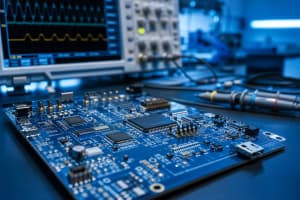
Board bring-up, driver work and the debugging that only happens with the hardware in front of you.

Optics, illumination and sensor selection, tuned until the inspection result is repeatable on the line.
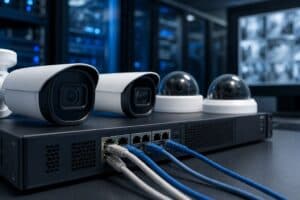
Real devices tested against real VMS platforms, at protocol level, before they reach an estate.
Why clients call us
Projects rarely stall in the middle of a layer. They stall between them.
The specialist supplier delivers exactly what was scoped, and the problem lives in the seam next to it. Here is where that shows up, and what it usually costs before anyone names it.
| The seam | How it presents | What it costs | What we do |
|---|---|---|---|
| Sensor to firmware | Image quality is fine on the bench and wrong on the line | Weeks lost between the optics supplier and the firmware team | Own both ends of the imaging chain and settle it |
| Firmware to platform | A driver works until the kernel or BSP moves | Release slips, and the fix is nobody's contractual scope | Platform and driver engineering under one team |
| Edge to control room | Analytics run correctly but never reach the operator | The AI investment delivers nothing visible to the customer | Metadata and event delivery through the real protocol path |
| Device to third-party system | Conformant on the datasheet, misbehaving on the VMS | Engineer visits, disputed liability, delayed handover | Protocol-level diagnosis and pre-deployment validation |
| Concept to programme | Nobody can say whether the hard part is achievable | A programme commits before the risk is understood | Applied R&D that answers the question before the spend |
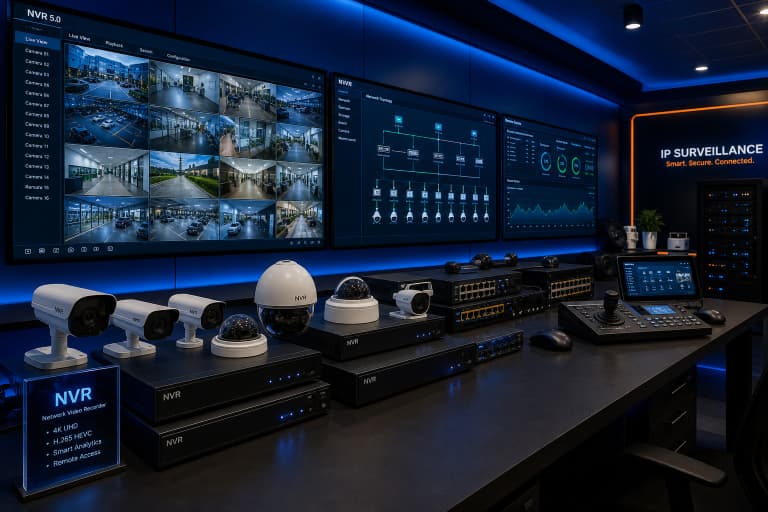
Sectors
Where the work lands
Regulated, long-lifecycle environments where a failure is expensive and an engineer has to be able to explain the decision years later.
Info
We publish the thinking, not the marketing
Standards move, and most of the cost lands on people who did not see it coming. Written for engineers rather than procurement.
Martyn's Law and Your CCTV: What Enhanced-Tier Premises Actually Have to Evidence
Read →30 Sep 2026Video interoperabilityProfile S to Profile T: The Engineering Migration Guide for Camera Manufacturers
Read →29 Sep 2026Video interoperabilityHow Much Storage Do 40 Cameras Need? A Worked Answer, With Sources
Read →27 Sep 2026Video interoperabilityWhat a VMS Really Costs: Per-Camera Licensing Over Five Years
Read →How an engagement runs
A call, a scope, then engineers on the problem
01 / SCOPE
Twenty minutes with our consultants
Not a discovery call with an account manager. You describe the problem to someone who can tell you on the call whether it is hard, and why.
02 / DE-RISK
A fixed-price first piece
An audit, a feasibility study or a test run against your platform. Defined deliverable, defined price, before anyone talks about a programme.
03 / DELIVER
Findings you can act on without us
A written plan, ranked by what each item costs you. If you take it in-house from there, that is a good outcome.
Track record
Deep-tech is the whole business, not a service line
DevSpark is a UK deep-tech engineering consultancy headquartered in Manchester, working across embedded systems, edge computing, ONVIF video-infrastructure compliance and applied R&D. Fifty-plus projects delivered over fifteen years, spanning ONVIF compliance and interoperability programmes for security manufacturers, CCTV estates for UK national infrastructure delivered under security clearance, and embedded and edge platforms in regulated industrial environments.
You list seven practices. Where is the specialism?
In one place: the layer where hardware, software and protocols meet. The list looks wide because the same seam arrives under different names - as a firmware problem, an optics problem, a platform problem or a conformance problem - and the practice it lands in depends on who noticed it first. If a problem is not deep in the stack, we are the wrong firm and will say so on the first call.
Can you take on part of a project, or does it have to be the whole thing?
Part is common. A lot of our work is subcontract engineering capacity for teams that are strong in their own domain and have hit something adjacent to it, or escalation work on an integration that has stalled.
Can you work under security clearance?
Yes. We hold security-cleared engineers and deliver CCTV and infrastructure work on secure sites, so the assurance, documentation and site access constraints that come with government, rail and highways programmes are routine for us rather than an exception.
Do you work outside the UK?
Yes, regularly across the DACH region. Correspondence and meetings can be conducted in German where that is easier.
What does the first piece of work usually cost?
It is fixed-price and scoped to a defined deliverable, so you know before it starts. The point of the first engagement is to de-risk the decision about a larger one, not to open an open-ended retainer.
Bring us the challenge
The one that has been handed back, sits between two suppliers, or nobody can say is possible yet. A short call costs you nothing and you will speak to one of our consultants.
Engineer to engineer. No handoffs.